Paint polishing removes fine scratches, swirl marks, and the dull finish caused by gradual wear of the clear coat—not by recoloring, but by finely sanding the top layer level. The result depends on the right combination of three things: a polishing compound with suitable abrasiveness, a polishing pad that mechanically applies the abrasive to the paint, and a polisher that provides the movement and speed. We also offer paint thickness gauges for safe inspection before sanding, degreasers to check the results after polishing, accessories (masking tape, pad cleaning, hand applicators), and specialized products for polishing windows and polishing chrome parts. You will find parts of complete systems from Koch Chemie, 3D, CARPRO, Gyeon, or Rupes, where the compound and pad are color-coded according to the level of abrasion.
Paint polishing removes fine scratches, swirl marks, and the dull finish caused by gradual wear of the clear coat—not by recoloring, but by finely sanding the top layer level. The result depends on the right combination of three things: a polishing compound with suitable abrasiveness, a polishing pad that mechanically applies the abrasive to the paint, and a polisher that provides the movement and speed. We also offer paint thickness gauges for safe inspection before sanding, degreasers to check the results after polishing, accessories (masking tape, pad cleaning, hand applicators), and specialized products for polishing windows and polishing chrome parts. You will find parts of complete systems from Koch Chemie, 3D, CARPRO, Gyeon, or Rupes, where the compound and pad are color-coded according to the level of abrasion.
How does paint polishing work, and when does a car need it?
Polishing is not just about one product – it’s a system of three consecutive steps, where choosing the wrong component (a compound that’s too aggressive, a pad that’s too hard) can do more harm than good.
When does paintwork need polishing?
The most common signs are spider-web swirls and holograms visible in sunlight or under artificial lighting, a dull appearance even after a thorough wash, or fine scratches that you can’t feel with your fingernail – polishing can take care of these, but not deeper scratches that reach the paint.
Paint thickness gauge
Before making any corrections, you should know the paint thickness – a gauge will show you how much clear coat remains and whether the car can be safely corrected at all, especially on panels that have been repainted. Skipping this step is the most common cause of burning through the paint during more aggressive correction.
Three steps in the polishing system
The compound determines the abrasiveness and chemical action, the pad spreads it mechanically and applies pressure according to its hardness, and the polisher provides the rotation and movement without the risk of overheating the paint. You can find details on each component in the categories Polishing Compounds, Polishing Pads, and Paint Polishers.
One-step vs. multi-step polishing
One-step products (All-in-One, One Cut & Finish) combine correction and finishing in a single step – they’re faster and safer on a thinner layer of paint, but offer less correction depth. Multi-step polishing (coarse → medium → finishing compound) takes longer, but can handle more pronounced defects and achieve a higher gloss.
DA vs. rotary polisher
The vast majority of polishers in our range are dual-action (DA) machines – unlike rotary polishers, their heads both rotate and move eccentrically, significantly reducing the risk of burning through the paint. A DA polisher is the safer choice for both home and advanced use.
Degreasers
After polishing, oil residues from the compounds remain on the paint, temporarily hiding minor defects and holograms. A degreaser (panel wipe) cleans the surface down to bare paint, so you can see the true result before applying wax or ceramic protection.
Polishing accessories
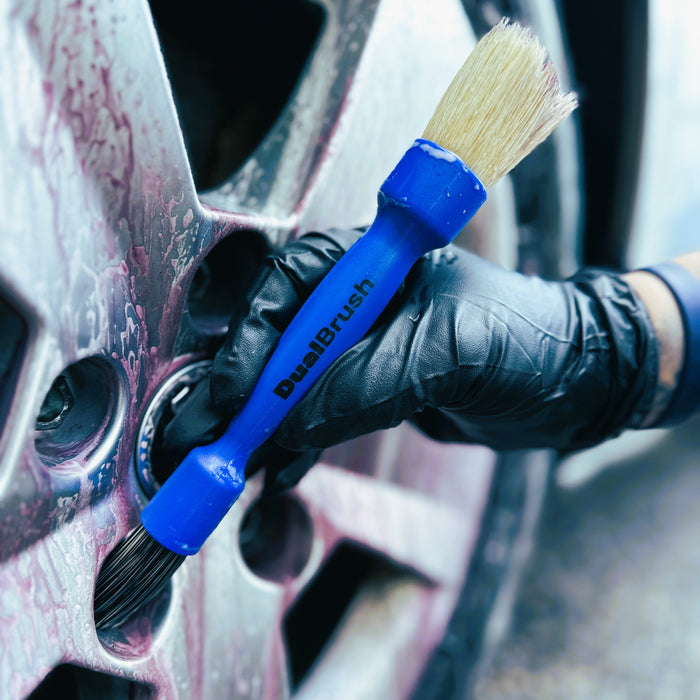
This category includes the small items needed for every polishing session – masking tape to protect plastic trim and mouldings, a brush for cleaning clogged pads, or hand applicator pads for areas the machine can’t reach.
Polishing chrome parts
Metal and chrome accessories (trim, badges, exhausts) need a different polish than paintwork – a special metal polish removes oxidation and restores the metal’s shine without risking scratches to the more delicate surface.
Window polishing
Wiper haze can’t be removed from glass with a regular cleaner – you need a special abrasive and a pad designed specifically for glass. You’ll find them in the dedicated Window Polishing category.